Friday, 16 April 2010

No Fools at The Cragwood

No Fools at the Cragwood

Sorry if we are a little late with this post but we have been pre-occupied with computers going bad, buying new ones and moving files.

We had the honour of photographing Kate and Justin’s wedding at The Cragwood on April 1st. We were a little worried about the date especially as we knew we were going to be working with The Cragwood’s manager, Phil, who, we all know, likes a joke. He was on his best behaviour though and the whole day was very much for real.

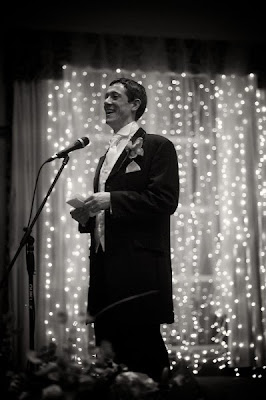
The brave guests ventured outside just long enough for us to make one big group picture but, as the snow capped hills show, it was freezing and everyone thought it best to get back in as soon as possible. Kate and Justin, being heated by nervous energy, dragged us down to the Lake to make a few portraits. We left soon after the speeches. Top of the bill was a riotous double act from Justin’s Best men.

We are very pleased with the pictures and we hope Kate and Justin love them as well. Best wishes to you both.


Saturday, 3 April 2010

The Art of Observation part 3

The next installment of the art of observation, an article on our approach to wedding photography.


Cheers

Josh


The art of Observation

Part 3

The Invisible Observer

Steven Taylor


A few years back, when observational wedding photography was still quite new to the UK, I read an article in a Photography Magazine. The magazine was from a new trade association for wedding photographers, I wasn’t a member and I didn’t subscribe to the magazine, they had sent it to me to persuade me to join. The article was called something like “ How to get the Look of Reportage Wedding Photography”. It went on to explain that “Reportage” was about making pictures in black and white and creating pictures that depicted the subject doing something, not looking at the camera. They talked about using fast film to accentuate the grain (pre-digital of course), they suggested printing in the border. My point is the whole article, as it said in the title, was about achieving a look. That premise for me was miles off the mark. I got that look to my pictures because of my approach to the wedding day, because of my philosophy of being an invisible observer.


As I have said before, I found contrived wedding photographs embarrassing to make, and if I did I am sure my subjects did. I didn’t like the way the photographer dominated the wedding day. I didn’t like the idea of bossing people around just to make a photograph and I found the whole starring into the flowers thing totally naff (the 21st century equivalent is the bride holding her veil above her head to blow in the wind), just my opinion you understand. So for me, “reportage wedding photography” wasn’t about a look, if it had been it would have gone out of fashion 10 years ago.

Around the same time I remember an album manufacturer’s rep telling me he had a customer who said he would like to do “reportage” but didn’t know what pictures to make.

Do you mind if I go back to calling the style observational? Thanks.

Observational wedding photography is about truth. It is about telling the story of the day as it was, not as the photographer contrived it. There is no shortage of images to make on the day; I imagine that the photographer the rep was referring to was more comfortable making portraits, and that is the point of why there is such a gulf between traditional and observational wedding photography.


Since professional photographers have photographed weddings, usually, the photographer of choice has been the local, high street, family portraitist. A family portrait photographer sells his pictures to the family he depicts. He wants to flatter the subject. The pose is carefully arranged, props are introduced and the subject is lit in the most flattering light. Often the images are retouched to smooth skin and remove blemishes. When these people photographed a wedding their training meant they had to control all of the elements. Also until relatively recently film quality wasn’t brilliant. Films were slow or very grainy and 35mm images didn’t enlarge well. So most photographers worked with medium format cameras that were the size, shape and weight of a brick. Unless you were built like Arnie the cameras were best mounted on tripods and when the light dropped it was time for flash. In the eighties, when I started making observational wedding pictures film technology went through the “T” grain revolution. That meant we had films that would work well in low light, without flash and 35mm negatives enlarged much better so we could leave the tripod at home.


As somebody who was very interested in documentary photography, I consumed all the books and went to all the exhibitions within that genre I could, I really couldn’t see how that methodology couldn’t work on a wedding day. So, combined with my assumption and all the new technology I set out to make observational wedding photography. What happened next was a whole new generation of wedding photographers that, like me, were not portraitists.

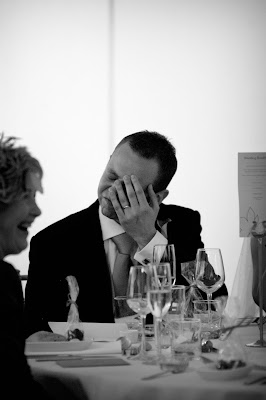
That all said I am still concerned with looking for flattering images. Now instead of moving the subject into the right light, I position myself so that the right light falls on the subject. Instead of posing the subject I watch for the subject to find the right pose for themselves. It’s all about observation; I have been to hundreds, maybe thousands of weddings. I know that at some point while the Bride is signing the register the Groom will adjust his new wedding ring, it’s a pretty good chance that when the Bride’s dad walks into the bedroom and sees his Daughter ready to go he will gasp, cry, smile and beam with pride and at some point during the Bestman’s speech the Groom will bury his face in his hands.

So, being an observational wedding photographer is all about being an invisible observer not a visible portraitist.
Friday, 26 March 2010

Coffee and the city....

We didn’t have a wedding last weekend so we spent it in London with four lovely couples. Our style of observational wedding photography doesn’t really lend itself to pre wedding shoots, or as Steven still calls them, engagement sessions. We normally like to photograph real life wedding days as events occur. Whereas the only reason for being photographed at a pre wedding shoot is to have your picture taken. It is inevitable then that pre wedding pictures are contrived. That said it is a perfect way to get to know your photographers. So, Steve, the couples and me are wandering the streets of our capital inventing real situations that look natural. We do like the results though.

Steve and Gosia are getting married in April in Islington and then they are having a reception in South Kensington. We met them on Saturday morning in Islington (coffee no.1) and had a walk on to the old Islington High Street where there is an “Arty” market place.


We had finished shooting with Steve and Gosia by 12 and we were not meeting Lenore and Andy until 1. As we had arranged to meet them on Upper Street in Islington we had a little wait (coffee no.2). We walked on to Highbury with Lenore and Andy, who are coming to the Miller Howe, just up the road from our studio, for their wedding in October. Arsenal were playing at home but it was a late kick off so we managed to avoid the crowds.


As is often the case at the moment there was a lot of engineering work on the Underground. The Jubilee line was closed right in the middle section so we skirted round to pick up the DLR …Nah! That was shut too. So after a little bit of ducking and weaving we got our selves back on an open section of the Jubilee line to find our way to Canary Wharf and meet up with Svetlana and Martin. With time to spare we opted for coffee no.3. We met Svetlana and Martin in their home. With true Australian/Russian/Irish hospitality they poured our 4th coffee of the day. Svetlana and Martin are planning their wedding in Tuscany for June 2011.


Once we had finished we were able to fly under our own power back to Cricklewood.

Sunday morning was much less frantic. We drove to East Finchley where we met Ola and Alex in their, new apartment. Just the one coffee and Viscount biscuits. Ola and Alex are getting married in East Finchley in August this year. We went to the Church first and then to the reception venue around the corner where we made these pictures.


We have been offering pre wedding shoots for quite a while. Now that we have shown these perhaps we will get taken up on the offer a little more.

It was lovely to meet you all after much E mailing and many phone calls and we are looking forward to all your weddings, maybe just the one coffee though.

Thursday, 11 March 2010

The Art of Observation Part 2

Part two of the art of observation, more to follow.

Josh


The Art of Observation

Steven Taylor


Part 2 Inspiration


As an observational wedding photographer I have set myself some ground rules. I draw on my first hero’s words to establish my rules.

“…Our task is to perceive reality, almost simultaneously recording it in the sketchbook which is our camera. We must neither try to manipulate reality while we are shooting, nor manipulate the results in a darkroom. These tricks are patently discernible to those who have eyes to see…”

Henri Cartier-Bresson from “The Decisive Moment” 1952.


If I am to live up to HCB’s words I need to become an invisible photographer, not literally but I would like to think when you look at my images it is like I was not there. There should be no influence from me. I have seen photographs of a bride apparently applying make up or adjusting her tiara in a mirror with an expression I cannot believe. She grins like she is slightly uncomfortable; she certainly appears to be aware of the camera. The expression on my subject’s faces are genuine, concentration, joy, pride, love, tenderness, nervousness, excitement and sometimes a tinge of sadness are all apparent on the faces of the people I have photographed at weddings over the last 20 odd years.


My style of wedding photography is principally concerned with narrative. Each individual image should tell a story and the collection in the album should tell a story of the day as a whole. When I approach a wedding I have the end result, the album, very much in my mind. I look for images that work together both from a narrative and a design point of view. When we sit down with the couple to build the album design it is narrative that takes precedence. That said, individual images need to be easy on the eye. I look for strong compositions; good and flattering light and impact. Most importantly, all of the images I make at a wedding should have integrity. I like to think that I make intelligent wedding pictures that are credible.


Friday, 5 March 2010

Keely and Will, Low wood Hotel, 28th Feb 2010

Latest update of Keely and Will shot at The Low Wood Hotel in the Lake District. Lovely day with a nice boat ride on the lake! Keeley and Will are on their honeymoon at the moment but we hope that this sneak peak will bring back some fond memories!


Friday, 26 February 2010

The Art of Observation Part 1

Steve does not generally get involved with the blog, facebook and tweeting but after a little bit of gentle coercion I have managed to get him to agree to write a series of articles about his approach to wedding photography. We hope that this may be of use to other photographers and our clients alike. There will be more parts to follow so do keep your eyes peeled.

Josh


The Art of Observation

Steven Taylor

Part 1 Historical Context


It was 1974, I was an art student, my photography tutor handed me a rangefinder camera and a roll of HP4. After a brief instructional talk on exposure, focusing and depth of field he sent me out to “waste film”. It was my first roll of 35mm, black and white film and I wandered the streets searching for a subject to use up the 36 frames. I can’t remember much about the pictures I made but when I got back I was taught to develop the film, make contacts, select and then enlarge an image. I glazed my print and dry mounted it on blue card. I recall the image, it was of a back of a bus; I’d love to see it again.

That was when I first got hooked on photography. The photographers I remember looking at in those early days were photojournalists, Henri Cartier-Bresson, Elliot Erwitt, Ian Berry and W. Eugene Smith were a few but I remember also being excited by the work of Ralph Gibson and Ray Moore as well as Paul Hill, who, later, taught me on an MA course. Gibson and Hill both started their careers as photojournalists while Moore had been a painter, all three, by the time I discovered them, were making very personal work in an observational style.

Two years later I was working for Ray Vincent. Ray was, and still is, a great photographer. He was, what we called in those days, a GP, he did everything. He made most of his income from weddings and portraits though. He would send me on a wedding with a Hasselblad and 6 rolls of 120 film. We would supply the customer with 60 images so I had to make 5 out of every 6 images count. There was little space for blinks or awkward poses. Exposure had to be right every time and if there wasn’t enough light to expose the 160 ISO rated film at a speed fast enough to freeze the subject we had to resort to flash. That meant every image had to be posed. There was a shot list; Groom and Best man with rings, Bride’s maids at Church gate, Bride sat on edge of car seat with one hand on door pillar and the other holding bouquet etc. In those days I hated wedding photography every week was the same.

I moved into other disciplines of the business. I did a lot of industrial and architectural photography. I worked for Shell and the BET group. As well as working with large format cameras I was often required to shoot in a journalistic style for company reports and “In-house” magazines. This was the photography I really enjoyed, the methodology that inspired me in the early days. When I became freelance I sought out editorial, press and PR work. I enjoyed the process of finding rather than constructing images. My personal work has always been about the found image.

Although I can’t remember a period of longer than a year, in the last 34, that I haven’t shot a wedding, at the end of the eighties I wasn’t relying on the wedding business to put bread on the table. So, when I got asked to shoot a wedding I agreed as long as I could work on my own terms. I wanted to work as an observer, to record events without interference, quietly shooting away, recording the full range of emotions of the day. I was in my element and the results were proving popular. When I opened a studio in Kendal in 1996 it was this style of wedding photography I promoted. By this time other photographers in the US, Australia and, just a handful in the UK had started to record weddings in a similar observational style. Some were giving the style names, “reportage”, “candid”, “documentary” and “photojournalistic”. I’m not keen on labels but if I have to choose one I’ll plump for “observational”.


The Art of Observation

Steven Taylor

Tuesday, 23 February 2010

Long time no post!....... Wedding Photography from Cheshire

First wedding back after a nice rest over Christmas! We are flat out now until October with a few spaces in between! If you are still taking your time over booking dont delay!


On to the wedding this is an update for Carl and Lisa who were married at the wonderful Peckforton Castle in Cheshire. Its our second time there this year and its dramatic surroundings and excellent service never fail to impress!

Here is a sneaky peaky!


First wedding back after a nice rest over Christmas! We are flat out now until October with a few spaces in between! If you are still taking your time over booking dont delay!


On to the wedding this is an update for Karl and Lisa who were married at the wonderful Peckforton Castle in Cheshire. Its our second time there this year and its dramatic surroundings and excellent service never fail to impress!

Here is a sneaky peaky!